JMHM Vol. 4, No. 1 is now officially released!
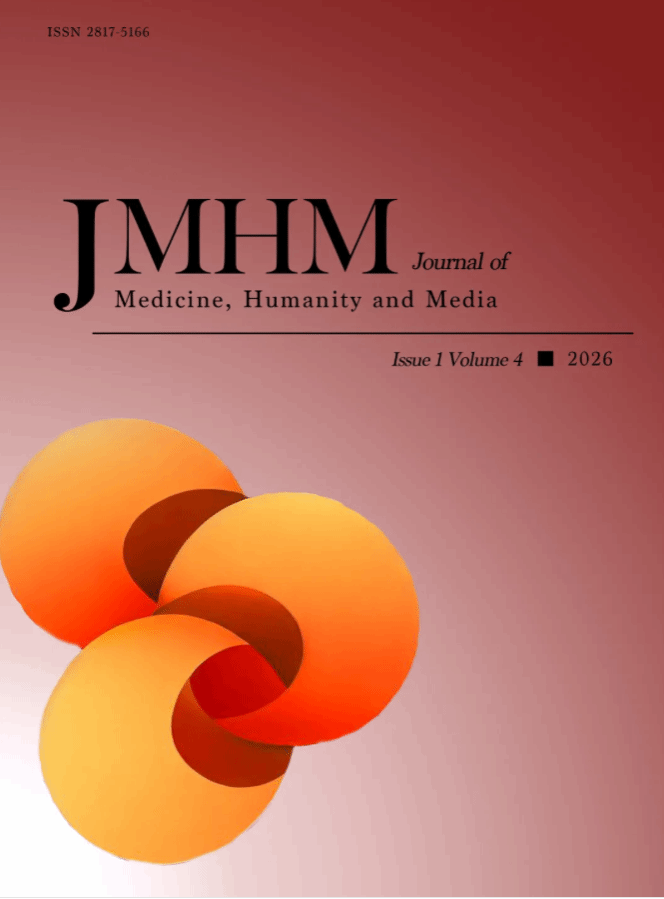
Cover Note
For this issue’s cover, the editorial team selected a vivid and passionate deep red as the dominant tone. The color evokes the festive warmth of traditional celebrations while symbolizing the surging momentum of scholarly inquiry at the dawn of a new year. As in previous issues, a gradient design is adopted, with hues flowing smoothly from a rich jujube red at the top to a softer light red at the bottom. This visual transition—from composure to brightness—metaphorically reflects the evolution of academic ideas from rigorous theoretical foundations toward open, practice-oriented applications, while also conveying a warm humanistic aspiration for health communication in the era of digital intelligence.
Issue Overview
This issue of Medicine, Humanity and Media (Vol. 4, No. 1) is themed “The Construction of Health Communication: International and Multidisciplinary Perspectives.” It features 12 state-of-the-art review articles by leading scholars in the field of health communication, along with three original research articles. Faculty members and students are warmly invited to read and engage with this issue.
Across the 12 review articles, technology emerges as a central focus. Studies by Jiang, Lwin, and Zhou illustrate how artificial intelligence, virtual reality, and mobile platforms enable personalized health interventions and expand their reach. At the same time, Dutta, Tufte, and van Weert caution against technological determinism, urging scholars to avoid reproducing structural inequalities.
These reviews also underscore the critical role of narrative. From Charon’s concept of narrative medicine, Caleb’s critique of “narrative as power,” Street’s framework linking clinician–patient dialogue to concrete health outcomes, to Zhou’s experimental research on role identity, the articles collectively reveal that storytelling functions not only as a therapeutic practice but also as a site of political negotiation.
Meanwhile, equity is no longer treated as a peripheral issue. Niederdeppe’s work on policy-related research, Zhao’s intervention designs, and Kreps’s empowerment framework all highlight the necessity of accounting for power asymmetries and social determinants of health.
The three research articles in this issue further demonstrate the field-building trajectory of health communication from interdisciplinary and international perspectives. They include: a cross-national comparison of ethical issues in medical AI, an empirical study on audiovisual media among Chinese diaspora youth, and a knowledge-mapping analysis of the international communication of Chinese higher education.
We extend our sincere gratitude to all authors and editors who contributed to this issue. We hope it will inspire further research, dialogue, and innovation in the vital field of health communication, and ultimately contribute to building a more adaptive and forward-looking body of knowledge.

About JMHM
Medicine, Humanity and Media (JMHM, ISSN: 2817-5166; indexed in Google Scholar) is the official academic journal of the MHM International Conference. Registered in Canada, the journal is dedicated to exploring the interdisciplinary intersections of medicine, media technologies, and health communication, with a strong humanistic orientation.
Early-career scholars are warmly invited to submit their work.
For submissions and registration, please visit: mhmjournal.net
The Journal of Medicine, Humanity and Media (JMHM) (ISSN: 2817-5166 | Indexed in Google Scholar) is the official academic journal of the MHM International Conference. Registered in Canada, it is dedicated to exploring the interdisciplinary intersections of medicine, media technology, and health communication with a humanistic focus.