From December 2 to 4 (local time), the 2025 World MOOC & Online Education Conference was held at the National Autonomous University of Mexico (UNAM). Peking University’s course “Introduction to Computation C” for the Physical Education major (Journalism and Communication track)—officially titled IC-PACE: Introduction to Computating– Python & AI for Communication Empowerment—was honored with the World MOOC & Online Education Alliance “Excellent Course Award: AI Special Recognition” (GMA Awards: AI Special Recognition).
The AI Special Recognition celebrates courses that innovatively apply AI technologies in teaching and leverage AI to transform learning experiences. In 2025, courses from 14 countries were shortlisted, and only 10 courses ultimately received this honor. IC-PACE was the only award-winning course with a humanities and social sciences background, highlighting Peking University’s leadership in interdisciplinary integration, AI-enabled higher education, and the development of the New Liberal Arts.

Note. Award Certificate
Course Overview and Teaching Team
The IC-PACE course is a joint initiative of Peking University’s School of Electronics Engineering and Computer Science, School of Journalism and Communication, and the Physical Education Teaching and Research Department. First launched in Spring 2025, it has been offered for two consecutive semesters and will continue as a long-term course. Targeted at student athletes in the School of Journalism and Communication, the course uses Python programming as a vehicle to cultivate computational thinking and AI collaboration skills.
The teaching team is led by Assistant Professor Ma Yun from the Institute for Artificial Intelligence (Spring 2025) and Postdoctoral Researcher Chen Mo from the School of Computer Science (Spring and Fall 2025). The course has received support from multiple initiatives, including the Peking University AI-Driven Curriculum Development Program, Undergraduate Teaching Reform Projects, and Practice–AI Integration Projects of the Office of Academic Affairs. It was nominated for the award by the Office of the Provost and the Center for Faculty Teaching Development.

Note. Teaching Team Receiving the Award
At the conference forum, Ma Yun and Chen Mo, representing the award-winning team, delivered keynote presentations introducing IC-PACE’s innovative philosophy and teaching practices to educators worldwide.
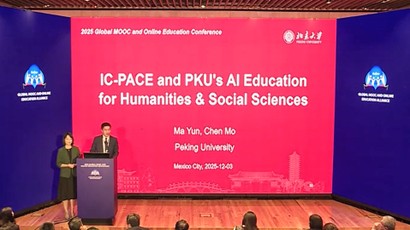
Note. Keynote Presentation by the Teaching Team
Educational Philosophy and Innovations
In his presentation, Ma Yun emphasized that the core of AI general education lies in cultivating computational thinking, with programming serving as a means rather than an end. He noted that since 2020, Peking University has upgraded the computer fundamentals requirement for humanities and social sciences students to “Introduction to Computation.” In 2024, the curriculum was further reformed to include the objective of training students to collaborate effectively with AI—a context from which IC-PACE emerged as an innovative practice.
Chen Mo highlighted that the course’s central goal is to develop learners who can use AI and programming to serve their own disciplinary needs. The course streamlines non-essential mathematical and algorithmic content found in traditional programming instruction and builds its teaching system around real-world tasks in journalism, communication, and sports, featuring over 100 original practice problems tailored to these fields. By the end of the course, with guidance from lectures and dedicated practice videos, students are able to independently connect to large language model APIs and develop intelligent applications.
Six Key Innovations Driving Teaching Reform
A New Form of Interactive Courseware
The course fully adopts Jupyter Notebook as the teaching medium, integrating theory, code examples, in-class exercises, and assignments into a single environment. Students can listen, run code, practice, and assess learning simultaneously—realizing a “learn–practice–test in real time” model.

Note. Advantages of Jupyter Notebook
A New Paradigm of “Learning with AI”
Beyond using AI tools, the course teaches students how to learn programming effectively with AI, including prompt engineering for large language models, debugging AI-generated code, and critically evaluating AIGC. A practice question bank tailored to journalism and communication was redesigned, enabling students to independently develop AI-powered applications by the end of the term.

Note. In-Depth Practice Video
An AI-Powered Q&A System
The team developed an LLM-based self-service Q&A system, “CyberTA.” Students can obtain answers aligned with the course progress simply by submitting a link. Surveys show that over 84% of students use the system frequently, and more than 92% turn to it first when encountering problems.

Note. CyberTA
Gamified Learning Design
A badge and achievement system visualizes learning progress—from “Hello World” to “Python’s Best Friend.” As students advance, they unlock skill badges at key milestones, making learning more engaging, motivating, and enjoyable.

Note. Badge System
Modular Design for Disciplinary Transfer
Other disciplines can retain the core instructional framework while replacing application scenarios and cases, allowing adaptation to fields such as sociological data analysis, historical text mining, and generative creation for arts students.
Open Sharing for Global Access
The team is translating the course into English, Spanish, and other languages and welcomes universities worldwide to adopt the complete course system.
Building an Inclusive AI Literacy Ecosystem
IC-PACE is one of the outcomes of Peking University’s AI General Education Foundation Curriculum System. This system offers three tiers of AI education—public foundational courses, core general education courses, and featured interdisciplinary and joint training programs—tailored separately for science/engineering and humanities/social sciences students. Together, they form an AI literacy education ecosystem that serves all students and extends to society at large.